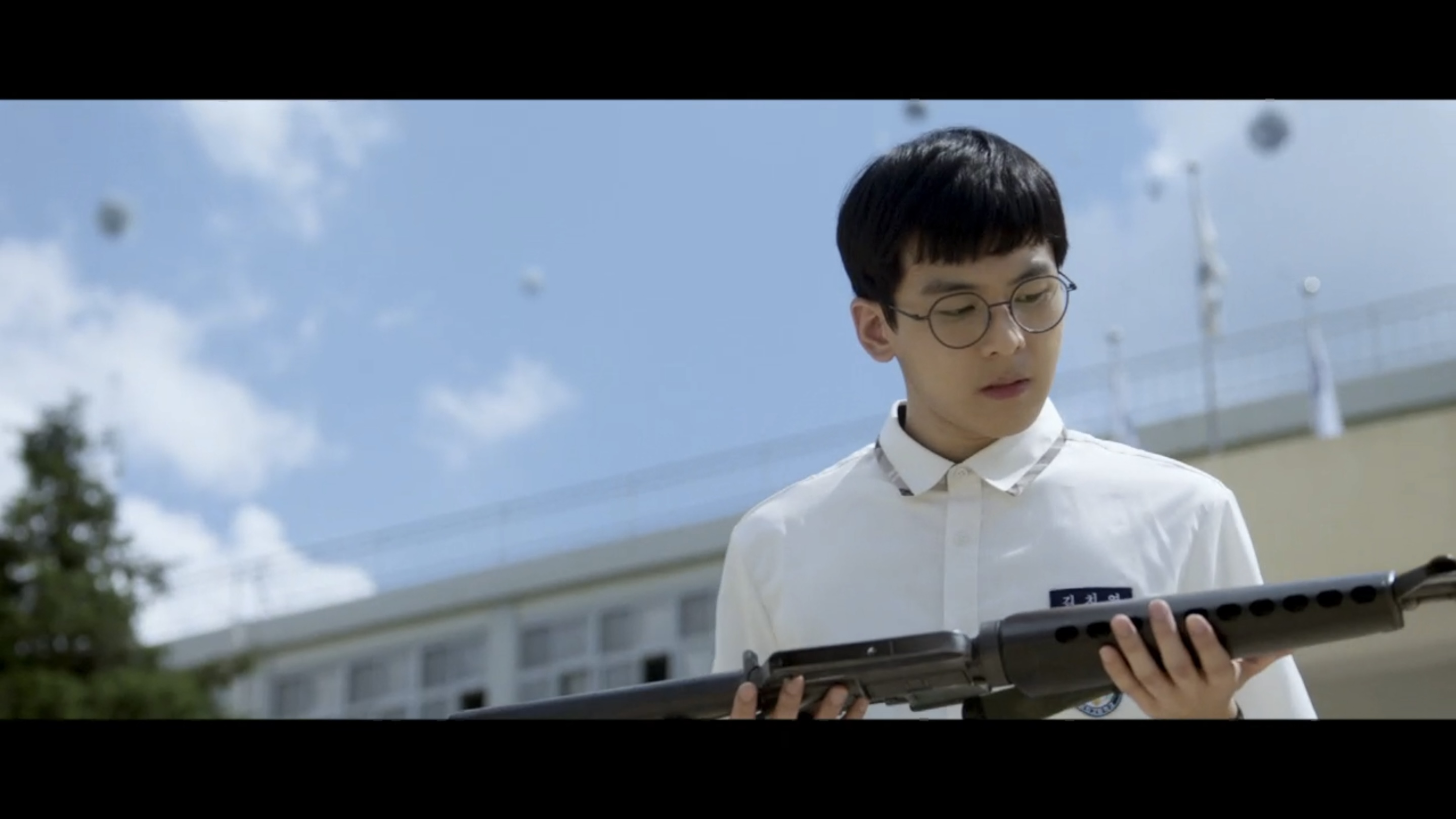
You probably went into it thinking it was just another All of Us Are Dead clone. High schoolers in uniforms, a mysterious threat, and a lot of screaming. But Duty After School Season 1 hit differently. It wasn’t just about the purple spheres falling from the sky or the kids being forced into military service; it was the psychological breakdown of Gen Z students who were told their CSAT scores mattered more than their survival. Honestly, looking back at the 2023 release on TVING, the show remains one of the most polarizing K-dramas in recent memory. Some people loved the gritty realism. Others felt absolutely betrayed by the final act.
What Duty After School Season 1 Actually Got Right About Horror
The spheres. Those floating, silent, violet orbs. They didn't move like typical movie monsters. For most of the first half of Duty After School Season 1, the tension comes from the unknown. These things just hang there in the sky, becoming part of the landscape until they suddenly snap and start tearing people apart. It’s a brilliant metaphor for the looming pressure of adulthood and exams, but on a much more literal, "get eaten by an alien" level.
The show doesn't waste time. By the end of the first episode, the Sungjin High School seniors are traded by the government. Their parents are lied to. The kids are promised extra credit for the CSATs if they join the reserve forces. Think about that for a second. In a world where academic success is the only way up, the government weaponized their ambition to turn them into soldiers. It’s dark.
The pacing in those early episodes is frantic. You've got Lieutenant Lee Chun-ho, played by Shin Hyun-soo, trying to balance being a hard-ass commander with the fact that he’s basically leading children to their deaths. His chemistry with the students—especially Kim Chi-yeol and the class clown types—gives the show its heart. Without that emotional anchor, the CGI action would feel empty. But it's the contrast between the kids trying to joke around and the sheer brutality of the sphere attacks that makes the first season stick in your brain.
The Military Realism vs. Teen Drama
A lot of viewers complained that the kids were "annoying." Yeah, well, they're teenagers. If you were told you had to pick up a rifle and shoot biological horrors instead of studying math, you’d probably have a breakdown too. The show captures that specific brand of teenage ego and fragility. You see it in the character of Gook Young-soo, whose obsession with the CSATs slowly turns into a full-blown psychosis. It isn't just a side plot; it’s the core of the tragedy.
One thing people often overlook is the tactical side. The show spent a decent amount of time showing the training—the botched drills, the heavy gear, the exhaustion. It wasn't "cool" military action. It was messy. It was desperate. When the students finally face the medium-sized spheres at the construction site or the camp, you feel their lack of experience. They aren't superheroes. They’re terrified kids with guns they barely know how to use.
The Turning Point: Why the Mid-Season Shift Mattered
Halfway through Duty After School Season 1, the tone shifts from survival horror to a character study on trauma. After the devastating losses at the school and the retreat, the group becomes a unit. They stop being "students" and start being "soldiers," but at a massive cost to their humanity.
The loss of their adult supervisors is the catalyst. When the students are left to fend for themselves, the power dynamics change. This is where the show draws inspiration from Lord of the Flies. Without the structure of the school system or the military hierarchy, the internal cracks start to widen. Small grudges about a girl or a misplaced comment suddenly become life-or-death conflicts because everyone is armed.
Characters Who Carried the Weight
- Lee Na-ra: The ace marksman. She’s the one everyone looks to, but the pressure of being the "strong one" clearly wears her down.
- Kwon Il-ha: The bully who finds redemption. It’s a trope, sure, but the way he eventually tries to protect the group feels earned.
- Cha So-yeon: Her mental health decline is one of the more realistic portrayals of PTSD in a genre show.
There's this one specific scene—you know the one—where they find an abandoned amusement park. For a brief moment, they’re just kids again. They’re laughing. They’re taking photos. It’s the most heartbreaking part of the season because you know it can’t last. The spheres are still there. The war isn't over. And the kids they were at the start of the semester are gone forever.
The Ending Everyone Is Still Screaming About
Let’s talk about the elephant in the room. The ending of the first season (technically the conclusion of the 10-episode arc) is controversial. If you haven't seen it yet, brace yourself. It doesn't end with a heroic victory over the aliens. It ends with a massacre that has nothing to do with the spheres.
Many fans felt that Gook Young-soo’s final arc was a betrayal of the story. They wanted a showdown with the "boss" alien. Instead, the show gave us a brutal reminder that humans are often more dangerous than the monsters. Young-soo’s descent into a murderous spree because of his fear of the exams and his resentment toward his peers was a gut-punch.
Was it a "good" ending? Honestly, it depends on what you wanted from the show. If you wanted a sci-fi epic, you were probably disappointed. If you wanted a cynical commentary on how society breaks young people, it was a masterpiece of nihilism. The final shots of the classroom—empty, bloodied, and silent—are haunting. The CSATs were eventually cancelled anyway. All that death, all that training, and the "reward" they were promised didn't even exist anymore.
Real-World Context and Why It Hits Different in South Korea
To understand the weight of Duty After School Season 1, you have to understand the South Korean education system. It’s high-pressure. It’s relentless. The CSAT (Suneung) is a day when the whole country goes quiet. Planes are grounded so they don't distract students during the listening portion of the English exam.
The show is a giant, bloody metaphor for that pressure. The spheres are the unexpected variables of life that the school system doesn't prepare you for. By forcing students to trade their education for survival, the government in the show is essentially admitting that the system they built is useless in a real crisis. This social commentary is what separates the series from a generic monster flick. It’s why it stayed in the top 10 on various streaming charts long after its release.
Misconceptions People Still Have
Some people think there’s going to be a "true" Season 2 that brings everyone back. As of early 2026, there’s no word of a direct continuation that ignores the events of the finale. The webtoon by Ha Il-kwon, which the show is based on, follows a similar—though slightly different—path of tragedy. The show took liberties with certain character deaths, but the core message remained the same.
Another misconception is that the spheres were sentient or had a "leader" we were supposed to meet. The show treats them more like a natural disaster or an invasive species. They don't have a manifesto. They don't want to talk. They just consume. That lack of motive makes them scarier because you can't reason with them.
Final Takeaways for Fans and New Viewers
If you’re planning a rewatch or diving in for the first time, keep your eyes on the background details. Look at how the school uniforms get dirtier and more tattered over time. Pay attention to the way the lighting changes from the bright, nostalgic tones of the first episode to the cold, blue hues of the finale.
Duty After School Season 1 is a tough watch. It’s not a "feel good" show. It’s a story about the loss of innocence and the failure of adults to protect the next generation.
Actionable Insights for Your Next Binge:
- Watch the Webtoon Comparison: If the ending bothered you, read the original webtoon. It provides a slightly different perspective on the internal monologue of the characters, especially Young-soo.
- Track the "Points" System: Notice how the obsession with the extra credit points for the CSAT drives the characters' decisions even when the world is ending. It’s the ultimate irony of the series.
- Look for the Cinematography Shifts: The transition from "civilian life" to "military life" is marked by a distinct change in camera work—shifting from steady shots to more handheld, shaky-cam styles to increase anxiety.
- Analyze the Adult Characters: Compare Lieutenant Lee with the other soldiers. He represents the only shred of moral authority left, which is why his fate is so pivotal to the students' eventual collapse.
The show remains a landmark in the "high school horror" subgenre, not because of the aliens, but because of what it says about the people fighting them. It’s messy, it’s heartbreaking, and it’s deeply uncomfortable. And that’s exactly why we’re still talking about it.
To dive deeper into the production side, check out the behind-the-scenes interviews with director Sung Yong-il, who discussed the challenges of filming with massive groups of young actors to maintain a sense of chaotic realism. If you're looking for similar vibes, Happiness or Sweet Home offer that same blend of societal critique and creature-feature horror. Re-watching the series with the knowledge of the ending changes everything—you start seeing the "villain" arcs forming in the very first episodes. Focus on the subtle isolation of certain students during the lunch scenes and drills; the foreshadowing is much stronger than it seems on a first pass.