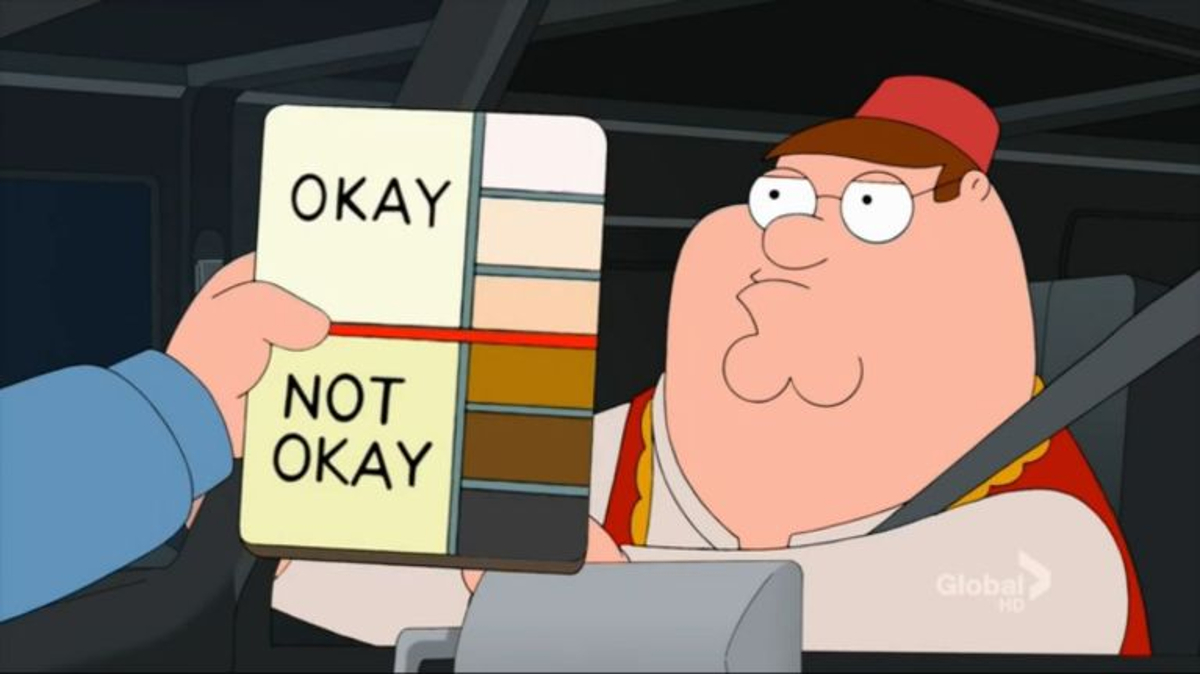
You've probably seen it. A bored-looking security guard holds up a laminated card next to a driver’s face. On that card is a spectrum of skin tones, ranging from a pale, "safe" beige at the top to a darker, "danger" brown at the bottom. It's the Family Guy skin color chart, and it has become one of the most resilient, versatile, and—honestly—uncomfortable memes in the history of the internet.
It’s weirdly effective.
Most people recognize it instantly. It captures a complex sociological concept—racial profiling—and boils it down into a single, absurd visual gag. But where did it actually come from? Is it just a joke from a cartoon, or is there something deeper going on with how we use it to talk about the world today?
Honestly, the context is everything here.
The Origin Story: "Turban Cowboy"
Let's clear something up right away. This isn't just some fan-made graphic that someone photoshopped in a basement. It’s a real scene from Family Guy. Specifically, it comes from Season 11, Episode 15, titled "Turban Cowboy," which originally aired in 2013.
In the episode, Peter Griffin joins the local police force. At one point, he’s seen at a checkpoint holding up a Family Guy skin color chart to determine which drivers to let through and which to harass. The joke is biting. It's a direct critique of the "stop and frisk" policies and racial profiling that were (and are) major points of contention in American policing. Seth MacFarlane and the writers weren't being subtle. They were aiming for the jugular of institutional bias.
It’s dark humor. That’s the Family Guy brand.
But once that image hit the internet, it evolved. It stopped being a specific critique of a police department and became a universal shorthand for any situation where someone is being judged—fairly or unfairly—based on their appearance. You see it in political discourse, sports commentary, and even in mundane debates about video game character creators.
Why the Family Guy Skin Color Chart Went Viral
Memes usually die fast. A week, maybe a month? Then they're gone. This one stuck.
Why?
Because it’s a "visual shorthand." You don't need a PhD in sociology to understand what that chart is saying. It represents the "us vs. them" mentality in its most basic, stripped-down form. When a news story breaks about a celebrity getting away with a crime, someone posts the chart. When a specific group is targeted by a new law, someone posts the chart. It has become a way for people to call out hypocrisy without having to write a 500-word essay on Facebook.
It works because it’s uncomfortable.
There’s a certain tension in the image. We laugh because the absurdity of a security guard using a literal color swatch to make life-and-death decisions is ridiculous. But we also cringe because we know, deep down, that this kind of bias exists. It’s what psychologists call "benign violation"—it violates a social norm (racism), but in a way that feels safe or satirical enough to be funny.
The Evolution of the "Terror" Scale
Over the years, the Family Guy skin color chart has been edited a thousand times.
Sometimes people swap out the colors for different things. I've seen versions where the colors represent different brands of soda, or different levels of spice in a hot sauce. But the most common variations keep the original meaning. They just apply it to new contexts.
During the 2024 election cycle, for instance, you couldn't scroll through X (formerly Twitter) for five minutes without seeing a version of this chart tailored to specific candidates or voting blocks. It’s a tool for political satire that anyone can use. You don't need to be a professional cartoonist to make a point with it. You just need a basic photo editor.
But we should probably talk about the controversy.
Is the Meme Problematic?
This is where things get tricky. Some people argue that by using the Family Guy skin color chart, we’re just trivializing actual racism. They say that turning systemic oppression into a "funny meme" makes it easier for people to ignore the gravity of the situation.
Is that true? Maybe.
On the other hand, proponents of the meme argue that satire is a vital tool for social change. By making the absurdity of racial profiling visible, we’re forcing people to confront it. It’s the "Emperor’s New Clothes" effect. If we can all point at the chart and laugh at how stupid the concept of judging people by skin tone is, then maybe we’re making progress.
It's a fine line.
Context matters more than anything. If someone is using the chart to mock a victim of profiling, that's obviously harmful. If they're using it to mock the system that does the profiling, that’s a different story entirely. Most internet users seem to intuitively understand this distinction, though the nuances are often lost in the chaos of a comment section.
The Science of Recognition
There's actually some interesting psychology behind why this specific image is so recognizable. The human brain is hardwired for pattern recognition. We like clear categories. The Family Guy skin color chart takes a complex human trait—melanin—and puts it into a neat, categorized box.
Even though we know it’s a joke, our brains respond to the structure of the chart. It mimics the look of a legitimate tool, like a Pantone color guide or a paint swatch book. This "official" look makes the satirical message hit harder. It looks like something a bureaucracy would actually create, which is exactly why it’s so unsettling.
Beyond the Screen: Real World Comparisons
Believe it or not, there are real-world versions of this that aren't meant to be funny. The Fitzpatrick scale, for example, is a real dermatological tool used to classify human skin color. It was developed in 1975 by Thomas B. Fitzpatrick as a way to estimate the response of different types of skin to ultraviolet (UV) light.
The Fitzpatrick scale has six categories:
- Type I: Always burns, never tans (pale white).
- Type II: Always burns, tans minimally (white).
- Type III: Sometimes mild burn, tans uniformly (cream white).
- Type IV: Burns minimally, always tans well (moderate brown).
- Type V: Rarely burns, tans very easily (dark brown).
- Type VI: Never burns (deeply pigmented dark brown to black).
When you look at the Family Guy skin color chart next to the Fitzpatrick scale, the resemblance is eerie. The meme is basically a cynical, distorted mirror of a scientific tool. It takes the objective reality of skin variation and applies a subjective, moralistic judgment to it.
That’s where the "funny" part stops and the "social commentary" part begins.
How to Spot a "Skin Color Chart" Moment in Pop Culture
Family Guy didn't invent this trope; they just perfected the visual representation of it. You see similar themes in movies like Blazing Saddles or shows like South Park. These creators use extreme exaggeration to point out the flaws in how society treats different groups.
When you're watching a show or a movie, look for these "chart" moments. They usually happen when:
- A character in power makes a snap judgment based on appearance.
- The audience is shown a literal or metaphorical list of "acceptable" vs. "unacceptable" traits.
- The absurdity of the criteria is highlighted through deadpan delivery.
The Family Guy skin color chart is essentially the "final boss" of this trope. It’s the most direct and unapologetic version of the joke.
Practical Takeaways for Navigating Internet Satire
If you're going to share or engage with the Family Guy skin color chart, there are a few things to keep in mind. First, know your audience. Not everyone finds this kind of humor funny, and for some, it can be genuinely triggering.
Second, think about what you're actually trying to say. Are you using the meme to punch up or punch down? Punching up—using satire to critique powerful institutions or systemic biases—is generally considered the "correct" way to use the chart. Punching down—using it to make fun of marginalized groups—is just being a jerk.
Third, remember the source. Family Guy is a show that thrives on being offensive. It’s not meant to be a moral compass. It’s a funhouse mirror. Use the meme for what it is: a sharp, cynical tool for pointing out the weirdness of our world.
Moving Forward
The Family Guy skin color chart isn't going anywhere. It has survived for over a decade because it taps into a fundamental truth about our society. As long as people continue to be judged by their appearance, this chart will remain relevant.
But maybe, by talking about it and understanding where it comes from, we can move toward a world where the chart is just a relic of a weirder time. For now, it remains one of the most powerful—and polarizing—images in the digital landscape.
If you're interested in how animation handles social issues, your next move should be looking into the history of "Adult Swim" satire or checking out how other long-running shows like The Simpsons have tackled similar themes over the decades. Understanding the lineage of this kind of humor makes it a lot easier to parse the next viral meme that hits your feed.
Actionable Next Steps:
- Audit your media consumption: Notice how often "visual shorthand" is used to represent different demographics in the news or entertainment you watch.
- Research the Fitzpatrick Scale: If you’re interested in the actual science of skin tones, look into how dermatologists use classification systems for health and safety.
- Check the context: Before sharing a meme like this, take two seconds to ask if it’s "punching up" or "punching down." It’ll save you a lot of headache in the long run.