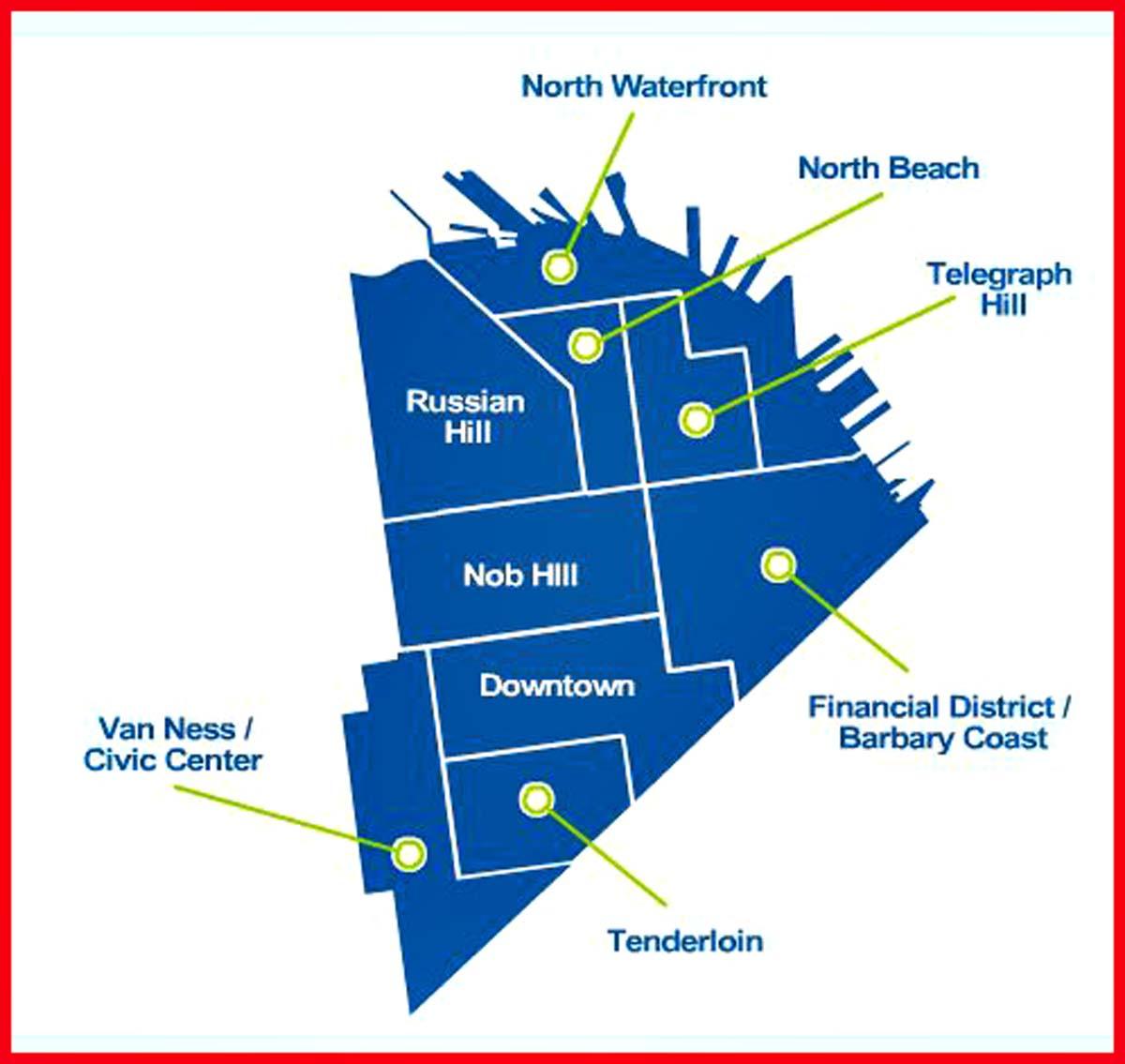
You’re looking at a Tenderloin San Francisco map and trying to figure out where the "safe" lines are drawn. It’s a common move. People do it every day before they book a cheap hotel or walk from Union Square to a concert at the Warfield. But here’s the thing: a digital map doesn't show you the humidity of the air, the smell of street food, or the specific block-by-block vibe that defines this neighborhood.
The Tenderloin is a paradox. It’s roughly 50 square blocks right in the heart of the city, bordered by Geary Street to the north, Market Street to the south, Mason Street to the east, and Polk Street to the west. If you look at a map, it looks like a perfect little grid. In reality? It’s arguably the most complex zip code in Northern California.
Reading the Tenderloin San Francisco Map Without the Bias
Most people pull up a map because they've heard the Tenderloin is "dangerous." They see the proximity to the Hilton Union Square or the luxury shops of Maiden Lane and wonder how two worlds can exist so close together. Honestly, the transition is jarring. You can be standing in front of a Gucci store and, three minutes later, you’re looking at a line for a needle exchange.
But if you just see a "no-go zone" on your screen, you’re missing the point. The Tenderloin is where the city’s soul lives. It’s home to the highest concentration of children in San Francisco. It’s the birthplace of the LGBTQ+ rights movement—specifically the Compton’s Cafeteria Riot of 1966, which happened years before Stonewall. When you look at the map, look for the intersections of Turk and Taylor. That’s history right there.
Why the Borders Matter (and Why They Don't)
The "Lower Nob Hill" designation is a classic real estate trick. It’s basically the northern edge of the Tenderloin. If you’re staying at a hotel on Post or Sutter, you might think you’re in a different world, but the city doesn't work in clean lines. The Tenderloin bleeds out.
The southern edge is Market Street. It’s a massive thoroughfare. On a Tenderloin San Francisco map, Market Street looks like a barrier, but it’s more like a bridge to the Mid-Market tech corridor. You have Uber and Twitter (now X) headquarters just a stone’s throw away from some of the most impoverished SROs (Single Room Occupancy hotels) in the country. It’s a stark contrast that defines the 21st-century San Francisco experience.
The Food Scene Most People Miss
If you're using a map to find dinner, you're actually in luck. The Tenderloin is home to "Little Saigon." Focus your eyes on the area around Larkin and Eddy Streets.
- Tu Lan: It looks like a hole in the wall. It is. But it’s also legendary. Julia Child used to eat here. Let that sink in.
- Brenda’s French Soul Food: This place on Polk Street is basically a pilgrimage site for anyone who likes crawfish beignets.
- Lers Ros: Phenomenal Thai food that doesn't hold back on the spice.
The neighborhood has a density of flavor that most "nicer" parts of the city can't touch. You just have to be okay with the fact that the sidewalk outside might be a little gritty. That’s the trade-off.
Safety, Perception, and the Real Street Dynamics
Let's be real for a second. If you look at a crime map of San Francisco, the Tenderloin is bright red. It’s the epicenter of the city’s drug crisis. Fentanyl has changed the dynamic of these streets significantly over the last few years.
You’ll see open-air drug use. You’ll see people in the middle of mental health crises.
But here’s the expert take: most of the "crime" is "street-involved." If you aren't part of the drug trade, you aren't typically a target for violent crime. It’s more about environmental stress. It’s loud. It’s dirty. It can be intimidating.
Navigating Like a Local
If you’re walking through, keep your head up. Don't be buried in your phone looking at your Tenderloin San Francisco map. That’s how you walk into a situation you didn’t mean to.
Walk with purpose.
Daytime is generally fine for anyone. The neighborhood is buzzing with activity—delivery trucks, social workers, families, and people grabbing coffee. Nighttime is different. Certain blocks, particularly around Turk and Hyde, get heavy. If you’re uncomfortable, stay on the main veins like Geary or O’Farrell. They are wider, better lit, and have more foot traffic from tourists.
The Architecture You’re Probably Ignoring
Because people are so focused on the street level, they forget to look up. The Tenderloin has some of the best-preserved pre-war architecture in the city. Since it didn't get "gentrified" in the same way as the Mission or Hayes Valley, many of the old neon signs and ornate facades are still there.
The Cadillac Hotel at Eddy and Leavenworth is a prime example. It was the first non-profit SRO in the city. It’s a massive, beautiful building that houses people who would otherwise be on the street.
The Great American Music Hall is another gem. The interior is stunning—marble columns, ornate balconies. It’s a world-class venue tucked into a block that most tourists would avoid.
Misconceptions About the "Map"
One of the biggest mistakes people make is thinking the Tenderloin is a monolithic "bad" area. It's actually a collection of micro-neighborhoods.
- The Theater District: The eastern edge near Union Square. This is where you find the Curran and the ACT. It’s glitzy, even if there’s some grit on the corner.
- Little Saigon: The western side near Polk. It’s cleaner, more residential-feeling, and packed with incredible food.
- The Core: The blocks between Leavenworth and Hyde. This is the heart of the "TL." This is where the social services are concentrated.
If you’re looking at a Tenderloin San Francisco map to plan a route, try to stick to the perimeter if you’re nervous. But if you want the best Banh Mi of your life, you have to go into the center.
Actionable Insights for Your Visit
Don't let the reputation stop you from seeing the real city, but don't be naive either.
- Avoid the "Sidewalk Stare": Don't look at the ground. Don't stare at people. Just walk.
- Use Public Transit Wisely: The 38 Geary and the 31 Balboa run right through here. They are usually packed and safe.
- Check the Time: Everything feels different after 10:00 PM. If you're not familiar with the area, use a rideshare to go door-to-door for nightlife spots like 826 Valencia’s King’s Lair or Whitechapel.
- Support Local: Buy a coffee at a local shop. The small business owners in the TL are some of the hardest-working people in San Francisco. They are the ones keeping the neighborhood alive.
The Tenderloin isn't something to be "solved" on a map. It’s a place that requires you to show up with an open mind and a bit of street smarts. If you can handle a little reality, it’s one of the most rewarding parts of San Francisco to explore.