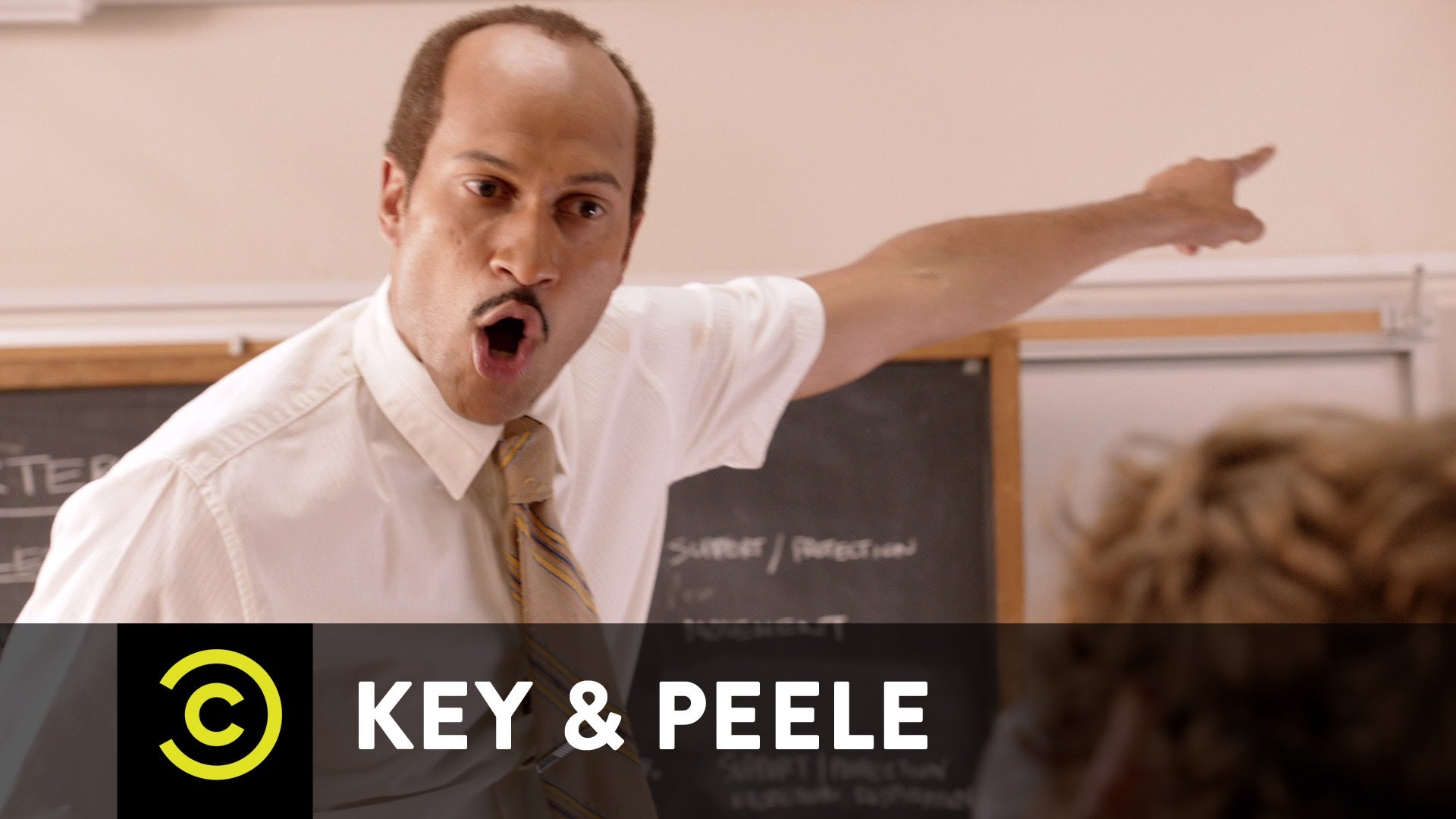
"A-A-Ron."
If you just read those three syllables and didn't immediately hear Keegan-Michael Key’s raspy, drill-sergeant voice in your head, you might be the only person on the internet who hasn't seen the "Substitute Teacher" sketch. It’s been well over a decade since the skit first aired on Comedy Central’s Key & Peele, and yet, it still feels as fresh as the day it dropped. Honestly, it’s one of those rare moments in comedy where everything—timing, cultural tension, and pure physical commitment—aligned perfectly to create a viral monster.
The premise is deceptively simple. Mr. Garvey, a veteran educator with 20 years of experience in the "inner city," finds himself subbing for a biology class in a predominantly white, middle-class suburban school. He walks in with a chip on his shoulder the size of a textbook, convinced that these kids are trying to play him. The result? A five-minute war over the pronunciation of common names like Aaron, Blake, and Denise.
Why the Key & Peele Substitute Teacher Sketch Works
Most comedy ages like milk, but Mr. Garvey has aged like a fine wine. Maybe a very angry, distrustful wine.
The brilliance isn't just in the mispronunciations; it’s in the "code-switching" in reverse. Usually, we see stories about students or teachers from marginalized backgrounds trying to navigate "white" spaces by softening their edges. Mr. Garvey does the opposite. He treats names like "Jacqueline" as if they are elaborate traps designed to mock his authority. When he screams "Jay-Quellin," he’s not just wrong—he’s aggressively, confidently wrong.
It flips the script on the real-world experience many people of color face when their names are mangled by others.
The Real People Behind the Names
While Keegan-Michael Key is the undisputed star here, the reactions from the "students" are what keep the sketch grounded. You’ve got:
- Zack Pearlman as Aaron (or A-A-Ron). He actually had pinkeye during filming and wore those goggles to hide it, which accidentally added a whole layer of "bullied nerd" energy to the character.
- Shelby Fero as Denise (Dee-Nice). Key actually improvised the "Say it right!" bit with her, and because she’s a pro improviser, she just rolled with it.
- Julian Sergi as Blake (Buh-Lock-Ay).
- Carlson Young as Jacqueline (Jay-Quellin).
Jordan Peele actually shows up at the very end as Timothy (or "Ti-mo-thee"), the only student Mr. Garvey trusts because he looks like the kids Garvey is used to teaching. It’s a brief, wordless performance that highlights the absurdity of Garvey’s bias.
The Origin of Mr. Garvey
Where did this guy come from? Keegan-Michael Key has mentioned in various interviews, including a great oral history with Entertainment Weekly, that the character was partly inspired by a real-life guidance counselor he had in his predominantly Black Catholic elementary school. That counselor was vigilant, intense, and always on the lookout for "chicanery."
Interestingly, the sketch almost didn't happen in the way we know it. One early pitch involved Mr. Garvey teaching a Spanish class using military-style phrases like "Help me, I'm kidnapped!" Thankfully, they leaned into the roll-call idea instead.
The writers' room apparently went into a frenzy once the "mispronounced names" idea was floated. Everyone had a name they wanted to see mangled. Names like Aaron and Blake were specifically chosen by Jordan Peele because they felt "really white" to him, heightening the cultural divide.
A Viral Legacy
The numbers are honestly staggering. As of early 2026, the original YouTube upload has surpassed 228 million views. That doesn't even count the countless TikTok rips, reaction videos, and the "Substitute Teacher Pt. 2" sequel where Garvey gets even more paranoid about school clubs.
It even spawned a Paramount+ commercial recently where Mr. Garvey takes roll call for characters like Dora the Explorer (D-Rah) and Blue from Blue's Clues (Bee-Louie). There was even talk of a feature-length movie at one point, though that seems to have stalled in development hell. Probably for the best—some things are perfect in five-minute bursts.
How to Apply the "Garvey Method" (Actionable Insights)
Look, you probably shouldn't scream at your coworkers and call them "mischievous and deceitful," but there are actually some things we can learn from why this sketch resonated so deeply.
- Acknowledge Name Identity: The sketch hits because our names are central to who we are. In a professional setting, taking the three seconds to learn the correct pronunciation of a colleague's name isn't just polite; it's a foundational sign of respect that avoids the "Garvey effect."
- Identify Cultural Blind Spots: Garvey’s struggle is a hilarious exaggeration of what happens when we refuse to adapt to a new environment. Whether you're entering a new industry or a new social circle, being aware of your own biases—and how they make you look to others—is key to survival.
- The Power of Physicality: If you’re a creator, notice how Key uses his whole body. He doesn't just say the lines; he snaps the clipboard, he looms over the desks, he vibrates with tension. Great content isn't just about the "script"; it's about the delivery.
If you ever find yourself in a room where someone calls out for "A-A-Ron," just remember: don't correct them. Just get your ass down to O-Shag-Hennesy’s office before they break a clipboard over their knee.
The cultural impact of Key & Peele is often discussed in academic circles regarding "post-racial" comedy, but at its heart, the substitute teacher sketch is just a masterclass in tension and release. We laugh because we’ve all felt that specific brand of "unearned authority" at some point in our lives.
Keep your names simple, and your "chicanery" to a minimum.