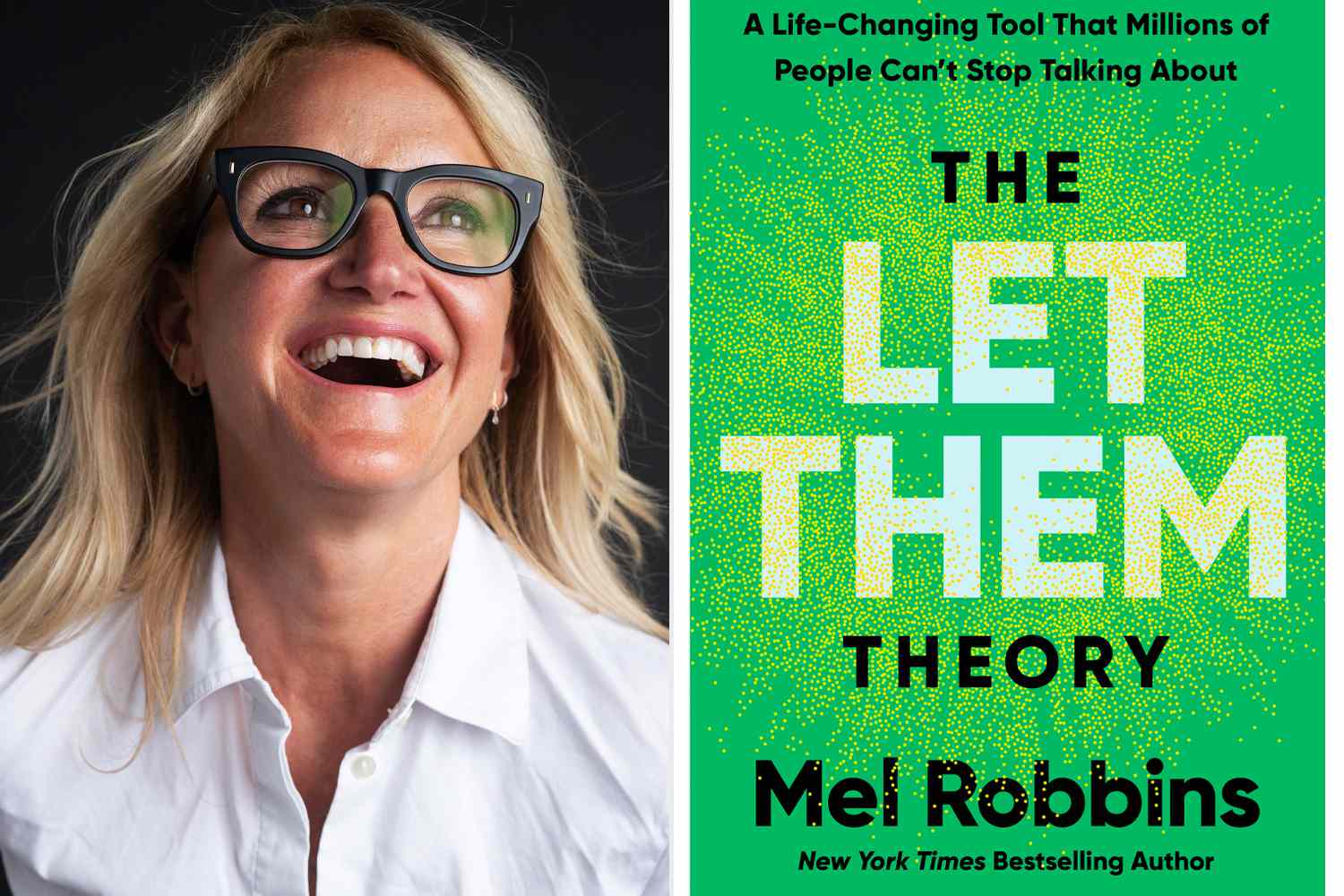
You’ve probably seen the videos. A woman with short, blonde hair stands in front of a camera, looks you dead in the eye, and tells you to stop fighting for attention. "If your friends didn't invite you to brunch? Let them." "If your partner doesn't want to go to the gym? Let them."
It sounds like ultimate freedom, doesn't it? It’s the Mel Robbins Let Them Theory, and it basically took over the internet in late 2023 and 2024. But behind the millions of likes and the "Let Them" tattoos, there is a messy web of plagiarism accusations, trademark drama, and therapists who are—to put it lightly—pretty worried.
The mel robbins let them controversy isn't just about a catchy phrase. It’s a case study in how modern self-help is made, packaged, and sometimes, allegedly "stolen" from the very people it’s meant to empower.
Where did "Let Them" actually come from?
If you ask Mel Robbins, she’ll tell you she "discovered" it while watching her son and his friends deal with prom drama in May 2023. She posted a video about it on May 19, 2023, claiming she had "just heard about this thing" and was obsessed with it.
But here’s the thing: social media receipts are forever.
Way back in 2022, a writer named Cassie Phillips wrote a poem called "Let Them." It went nuclear on TikTok and Instagram long before Mel’s prom story. People were literally posting photos of their "Let Them" tattoos a full year before Mel’s video dropped.
When the controversy started bubbling up, Mel’s defense was basically that the idea is "ancient wisdom." She’s cited Stoicism, Buddhism, and the Serenity Prayer. Honestly, she’s not wrong that the concept of radical acceptance is old. But critics, including a lot of people in the "Life Coach Snark" communities, point out that using the exact same two-word "hook" without acknowledging the viral poem that preceded her is a bit... convenient.
The Trademark Battle
Things got even weirder when Robbins' team tried to trademark the phrase "LET THEM" (Serial No. 98643523) for books, courses, and merchandise.
Talk about a backfire.
The USPTO (United States Patent and Trademark Office) has a "failure to function" doctrine. Basically, if a phrase is so common that it’s just a "general life philosophy," you can’t own it. It’s like trying to trademark "Be Happy." The attempt to monetize a phrase that many believe belonged to the public—or at least to Cassie Phillips—turned the "let them" peace into a full-scale PR headache.
Why Therapists Are Low-Key Panicking
While you're "letting them" do their thing, some mental health experts are raising a red flag. On the surface, the theory is just Radical Acceptance from Dialectical Behavior Therapy (DBT). It’s about accepting reality as it is.
But there’s a dark side.
- Avoidance vs. Acceptance: Some critics argue that "Let Them" is just a fancy way to avoid hard conversations. If your boss is exploiting you, "letting them" isn't a strategy; it’s a recipe for burnout.
- The Trauma Trap: In toxic or abusive relationships, "letting them" can be dangerous. Therapists like Maren Oslac have pointed out that "let them" can become an excuse for people to look away when they should be standing up.
- The Disconnect: Brené Brown’s work is all about vulnerability and connection. Some argue that Robbins' theory does the opposite—it encourages a sort of cold detachment that makes real intimacy impossible.
Mel eventually added a "Let Me" component to the theory to address this. The idea is: "Let them [behave poorly], and let me [decide to leave/set a boundary]." But in the fast-paced world of TikTok, the nuance usually gets lost.
The Timeline Inconsistencies
One of the loudest parts of the mel robbins let them controversy is the "Discovery Story."
In her book The Let Them Theory (released in late 2024), Robbins leans heavily into the story of her son’s prom. However, internet sleuths like Andy Mort and Sage Justice have pointed out that her original video about the theory was actually posted the day before the prom event she says inspired it.
Is it a small detail? Maybe. But for a guru whose brand is built on "authentic truth," these timeline hiccups make people wonder how much of the "theory" is real life and how much is just clever marketing.
What You Should Actually Do With This
So, is the "Let Them" theory total garbage? No. It’s actually a pretty great tool for minor annoyances.
If someone cuts you off in traffic? Let them. If your mother-in-law makes a passive-aggressive comment about your rug? Let her.
But for the big stuff—your career, your safety, your deep relationships—you need more than a two-word mantra.
Here is the expert-backed way to actually use the tool without falling into the trap:
- Audit the Stakes: Ask yourself, "Is this person’s behavior harming my safety or my core values?" If yes, "Let Them" is the wrong tool. You need a boundary.
- Acknowledge the Source: If you’re sharing the idea, give a nod to the fact that this is a blend of ancient Stoicism and modern poets like Cassie Phillips. It keeps the "karma" of your content clean.
- Use the "Let Me" Phase Immediately: Don't just stop at letting them be annoying. Immediately ask, "What am I going to do for myself right now?"
- Don't Ghost, Communicate: If a friend keeps leaving you out, you can "let them" not invite you, but you should also probably tell them it hurts your feelings. Silence isn't always strength; sometimes it’s just a lack of communication skills.
The real lesson from the mel robbins let them controversy isn't about whether Mel Robbins is a "grifter" or a "genius." It’s a reminder that we shouldn't outsource our entire mental health to a 60-second clip. Use the mantra for the small stuff, but keep your hands on the wheel for the things that actually matter.
If you’re ready to apply this without the drama, start by identifying one "low-stakes" person in your life today—someone who just bugs you—and consciously choose to "let them" be exactly who they are for the next 24 hours. See how much energy you get back.