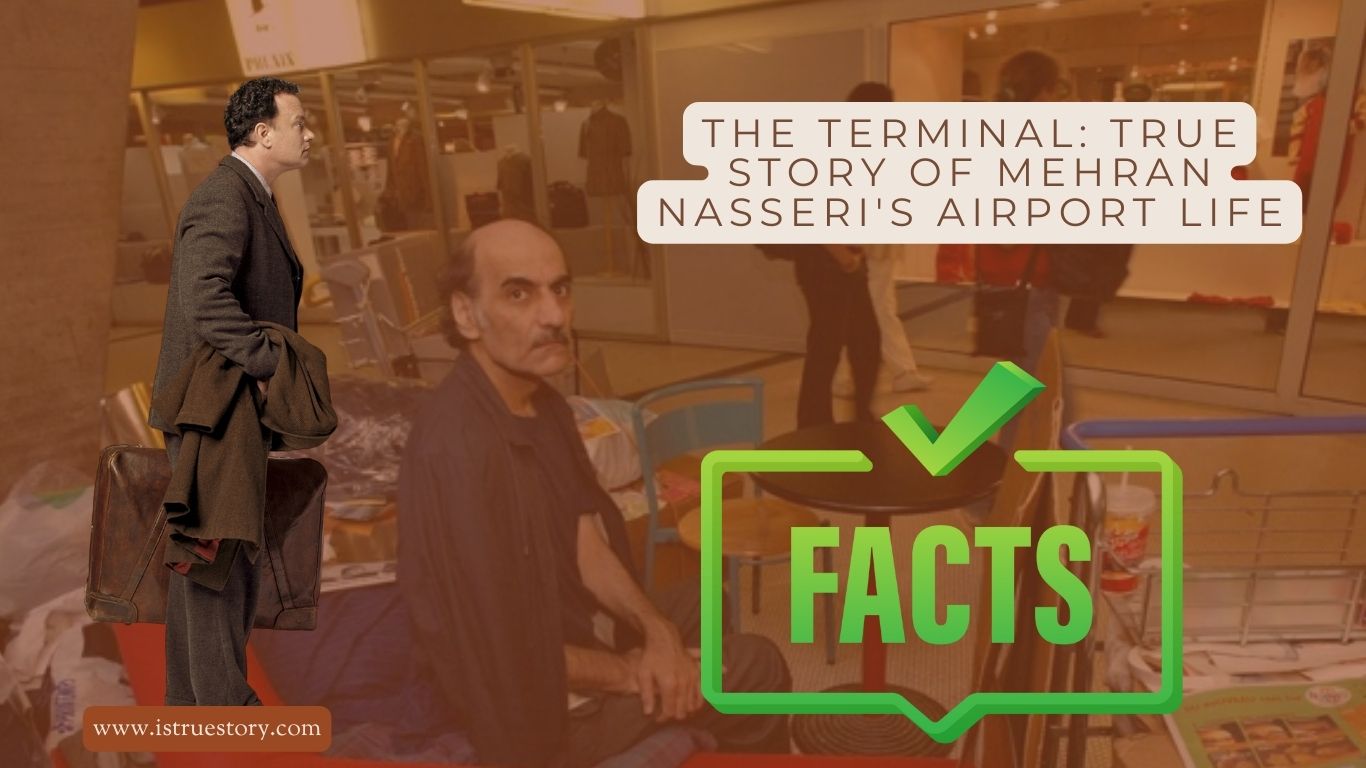
Steven Spielberg has a knack for making the impossible feel like a cozy Sunday afternoon. In 2004, we saw Tom Hanks as Viktor Navorski, a lovable guy from the fictional country of Krakozhia who gets stuck in JFK Airport because his country collapsed while he was in the air. It’s a great movie. But the Terminal movie true story is a lot weirder, darker, and honestly, more frustrating than anything Hollywood put on screen.
The real man was Mehran Karimi Nasseri. He didn't live in a shiny New York terminal for a few months while waiting to date a flight attendant. He lived in Terminal 1 of Paris-Charles de Gaulle Airport for eighteen years.
Eighteen.
Think about that for a second. You know that feeling when your flight is delayed three hours and you start to lose your mind because the Cinnabon is closed? Now imagine that being your entire existence from 1988 until 2006. No bedroom. No privacy. Just a red plastic bench and a bunch of luggage.
Who was the man behind the Terminal movie true story?
Mehran Karimi Nasseri, who eventually started calling himself "Sir Alfred," wasn't some bumbling tourist. He was born in Masjed Soleyman, Iran. His life was a mess of geopolitical red tape long before he ever saw a French runway. In the late 70s, he claimed he was expelled from Iran for protesting the Shah.
He spent years wandering around Europe, applying for political asylum in different countries. Eventually, the United Nations High Commissioner for Refugees in Belgium gave him refugee status. This is where things get wonky. According to Nasseri, his briefcase—containing his refugee documents—was stolen at a train station in Paris.
He got on a plane to London anyway.
When he landed at Heathrow, he couldn't prove who he was. The British sent him right back to where he came from: France. But since he had no papers, the French couldn't let him into the country, and they couldn't deport him because they didn't know where to send him.
He was stuck in a legal "no man's land." He basically became a human ghost in the middle of one of the busiest airports in the world.
The reality of living in Terminal 1
The movie makes it look kind of whimsical. Tom Hanks finds a way to make money, builds a fountain, and helps people out. The real Terminal movie true story was much more about the slow grind of daily survival.
Nasseri lived on a circular red bench in the basement of Terminal 1. He kept his life in cardboard boxes. He spent his days writing in his diary, reading newspapers, and watching the travelers pass by like a river. He wasn't some high-energy guy running around looking for work; he was a fixture.
The airport staff actually looked out for him. They’d bring him newspapers and food. He’d wash up in the public restrooms early in the morning before the crowds arrived. He was meticulous. He kept his area clean. He sent his clothes to the cleaners. He wasn't a "homeless man" in the traditional sense; he was a resident of the airport.
Why didn't he just leave?
This is the part that drives people crazy. In 1999, his lawyer, Christian Bourget, and a French human rights doctor finally won a case that granted Nasseri the right to live in France.
He refused to sign the papers.
Why? Because the documents listed him as an Iranian citizen and used his birth name, Mehran Karimi Nasseri. By then, he had fully committed to the persona of "Sir Alfred." He insisted he wasn't Iranian and that his papers should reflect his new identity.
Honestly, after a decade of living in a terminal, your brain probably adapts. The airport was safe. The outside world was terrifying and had rejected him for years. The terminal was the only place that actually "accepted" him, even if it was because of a legal loophole.
The Spielberg connection and the $275,000
DreamWorks reportedly paid Nasseri roughly $275,000 for the rights to his life story. That’s a life-changing amount of money for most people, especially someone living on a bench.
But it didn't change his life.
He used the money to... stay in the airport. He didn't buy a house. He didn't travel. He sat on his bench with his boxes. Eventually, in 2006, he was hospitalized for an ailment and had to leave the airport for the first time in nearly two decades. After that, he lived in a shelter in Paris, supported by the money from the movie.
The tragic ending you didn't see in the credits
If you're looking for a "happily ever after," the Terminal movie true story doesn't really have one. It has a full circle.
In late 2022, Mehran Karimi Nasseri moved back to Charles de Gaulle Airport. He went back to Terminal 2F this time. After years of living in shelters and hotels, he returned to the place that defined him.
He died there in November 2022, at age 77, after suffering a heart attack.
He was in an airport terminal, surrounded by his belongings, just like he had been for the best years of his life. It’s a weirdly poetic, albeit heartbreaking, conclusion. He wasn't a prisoner of the state anymore; he was a prisoner of habit, or perhaps, a prisoner of the only home he truly knew.
What Hollywood got wrong (and why it matters)
Movie audiences want a hero who overcomes the system. We want to see Viktor Navorski get the girl and go home to celebrate his father's legacy. It’s uplifting. It’s classic Spielberg.
The real story is a critique of bureaucracy. It’s a story about how a person can fall through the cracks of international law and never crawl back out. It’s about mental health and the way extreme isolation—even in a crowd of thousands—can break a man's sense of self.
Nasseri's case wasn't unique because of his "zany" situation. It was unique because of his refusal to be anyone other than "Sir Alfred." He chose his identity over his freedom, which is a pretty profound thing when you think about it.
How to research the real Mehran Karimi Nasseri
If you want to dive deeper into the gritty details of this story without the Hollywood filter, there are a few places to look.
- Read his autobiography: He actually wrote a book called The Terminal Man with British author Andrew Donkin. It gives you a much better sense of his internal state than any movie ever could.
- Check the 1990s news archives: The New York Times and The Guardian covered his legal battles extensively throughout the 90s. These contemporary reports show the frustration of his lawyers.
- Look for "Sir Alfred": Many of the most authentic accounts refer to him by his chosen name, rather than his birth name.
The Terminal movie true story teaches us that reality is rarely as clean as a three-act structure. It’s messy, it’s bureaucratic, and sometimes, the person stuck in the terminal isn't trying to get out—they're just trying to be seen for who they think they are.
If you're ever in Charles de Gaulle, take a look at the benches. The man is gone, but the legacy of the world's most famous "stateless" person still hangs over those hallways. It’s a reminder that a passport is just a piece of paper until it’s the only thing standing between you and a bed.
To truly understand the nuance of this case, compare the legal definitions of "refugee" versus "stateless person." The distinction is exactly what kept Nasseri in Terminal 1 for 18 years, and it remains one of the most complex hurdles in international law today. Take a look at the UNHCR guidelines on statelessness if you want to see just how many people are currently living in versions of Nasseri’s reality, even if they aren't living on a red bench in Paris.