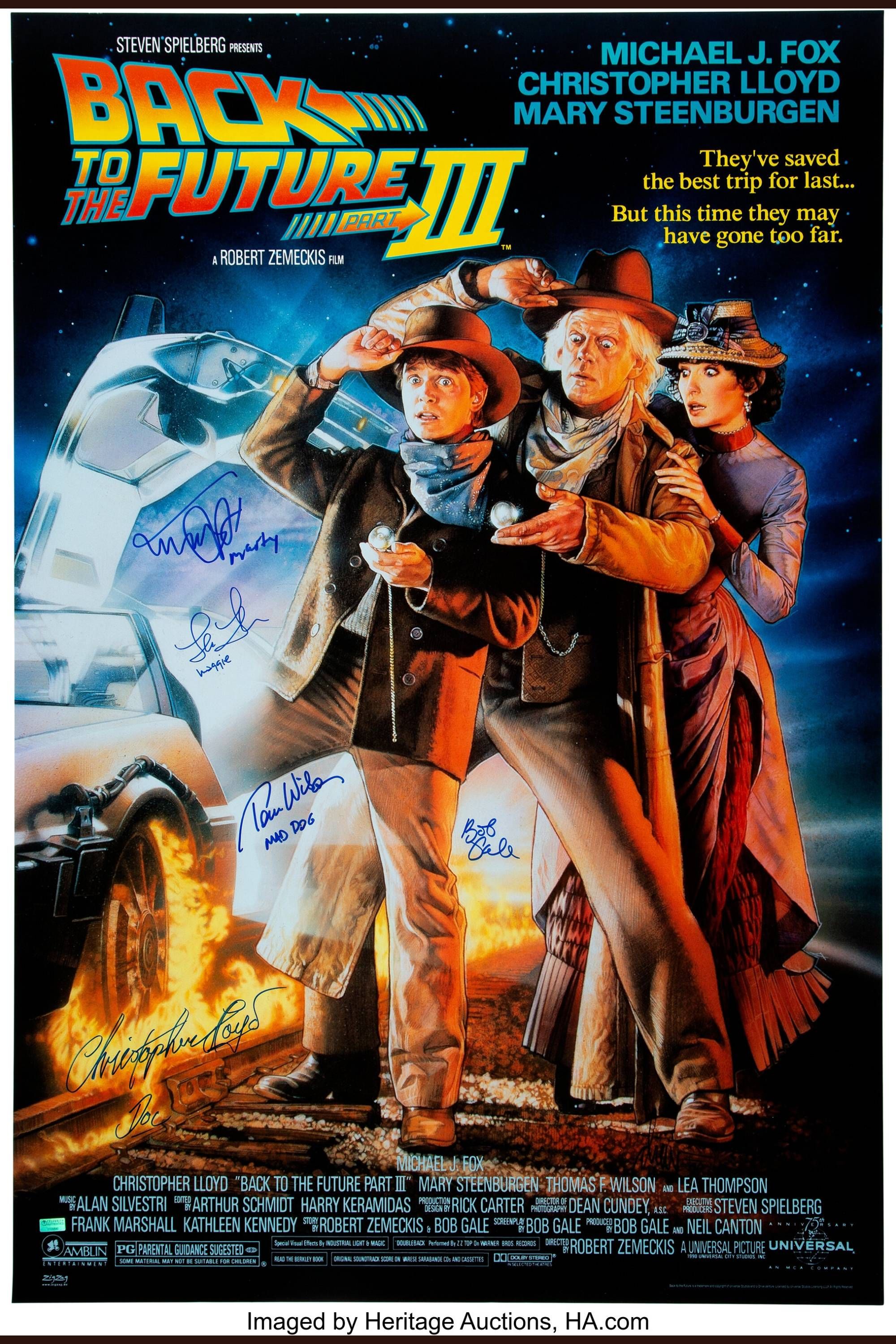
People usually rank the second one as the "cool" sequel and the first one as the untouchable masterpiece. But honestly? Back to the Future Part III is where the heart of the series actually lives. It’s weird. It’s a Western. It replaces high-tech hoverboards with steam-powered locomotives and manure spreaders. When Robert Zemeckis and Bob Gale decided to film the sequels back-to-back, they took a massive gamble by pivoting from the neon-soaked cyberpunk aesthetic of "2015" straight into the dusty, 1885 grime of Hill Valley.
It worked.
The movie isn't just a genre exercise. It’s the only film in the trilogy where Emmett "Doc" Brown becomes a fully realized human being instead of just a walking plot device with wild hair. For the first time, we see him vulnerable. He falls in love. He considers throwing away the space-time continuum for a schoolteacher named Clara Clayton. That shift in stakes—from saving the world to saving a relationship—is why the movie feels so grounded despite the flying trains.
The Wild Shift from Neon to Dust
Most sequels try to outdo the original by doing "more" of the same. More gadgets. More time jumps. More convoluted alternate realities. Back to the Future Part II did that to the point of exhaustion, leaving audiences in 1989 feeling a bit dizzy. When Back to the Future Part III hit theaters in May 1990, it felt like a collective exhale.
The production was grueling. Michael J. Fox was exhausted, literally flying back and forth between the set of the sitcom Family Ties and the movie's locations. He almost died during the hanging scene at the courthouse—that wasn't just acting; he actually passed out because the stunt went wrong. You can see the weariness in Marty McFly’s eyes, and weirdly, it fits. Marty isn't the cocky kid who invented rock and roll anymore. He’s a guy who just wants to go home.
Zemeckis shot this film in Sonora, California, and Monument Valley. He wanted that John Ford look. He got it. The sweeping vistas aren't CGI; they are real, towering sandstone buttes that make the DeLorean look like a tiny, silver toy lost in the wrong century. It’s a visual clash that shouldn't work, but it does because the film commits 100% to the Western bit.
Why the 1885 Setting Was a Stroke of Genius
Think about the technical limitations. In 1955, Doc could find some industrial-grade capacitors or a hardware store. In 1885? Nothing. They don't even have gasoline. This forced the writers to get creative. How do you get a car up to 88 miles per hour without an internal combustion engine? You use a train.
That train sequence is arguably the best-edited climax in the entire franchise. It’s visceral. The "Presto Logs" exploding in different colors—green, yellow, red—create a literal ticking clock that even a kid can understand. It’s a masterclass in building tension without relying on a digital countdown.
Doc Brown’s Emotional Evolution
For two movies, Christopher Lloyd played Doc Brown as a manic, borderline-dangerous scientist. He was the mentor. In Back to the Future Part III, he’s the protagonist.
When Doc meets Clara Clayton (Mary Steenburgen), the movie transforms into a romance. This was a huge risk. Imagine telling a bunch of ten-year-olds in 1990 that their favorite time-travel movie was now about a middle-aged man falling in love. But Steenburgen and Lloyd have this incredible, dorky chemistry. They’re both outsiders. They both love Jules Verne.
It’s the first time we see Doc prioritize his own happiness over the "rules" of time travel. It’s a beautiful character arc. He starts the series obsessed with the future and ends it realizing that the future hasn't been written yet.
"Your future is whatever you make it, so make it a good one."
That line isn't just a Hallmark card sentiment. Within the context of Doc’s life, it’s a hard-earned realization. He spent his life trying to control time, only to realize that living in the present—even if that present is 1885—is the only thing that matters.
The "Clint Eastwood" Paradox
Marty calling himself Clint Eastwood is one of the best running gags in cinema. It’s meta, but it also serves the plot. Marty is trying to be someone he’s not. He’s obsessed with his reputation. Throughout the trilogy, if someone calls him "chicken," he loses his mind.
The Western setting provides the perfect backdrop for Marty to finally outgrow his biggest flaw. The showdown with Buford "Mad Dog" Tannen isn't won because Marty is a fast draw. It’s won because he uses his brain—and a cast-iron stove lid—to survive.
He stops caring about being called a coward. That is his real character growth. When he returns to 1985 and refuses to race Needles (played by Flea from the Red Hot Chili Peppers), he avoids the car accident that would have ruined his life. The 1885 adventure actually saved him.
Technical Details Fans Often Miss
- The Photo: The iconic photo of Marty and Doc at the clock tower was actually taken during the production of Part III, obviously, but it becomes the emotional anchor for the whole series.
- The Music: Alan Silvestri’s score for Part III is incredible. He took the heroic theme from the first movie and rearranged it into a sweeping, orchestral Western theme. It feels bigger.
- The Cameos: Those old guys in the saloon? Those are real Western icons, including Dub Taylor and Pat Buttram. Zemeckis was paying homage to the genre's history.
- The DeLorean's Fate: Watching the DeLorean get absolutely demolished by a freight train at the end is still one of the most shocking moments in 90s cinema. It was a signal: the adventure is truly over. No more sequels. (Until the cartoons and comics, anyway).
Addressing the "Worst in the Trilogy" Myth
For years, critics and casual fans labeled this the weakest link. They said it was too "silly" or that the Western setting felt out of place. I’d argue the opposite. Part II is the one that’s actually a bit messy. It’s dark, cynical, and gets tangled in its own paradoxes.
Back to the Future Part III is a return to form. It’s a linear story with a clear beginning, middle, and end. It’s fun. It has a train heist. It has a hoverboard save that mirrors the first movie but adds stakes. It feels like a complete movie rather than just the second half of a cliffhanger.
If you haven't watched it lately, you'll notice how well the practical effects hold up. The model work for the train crash is spectacular. Industrial Light & Magic (ILM) was at the top of their game here. There’s a weight to the machines that modern CGI just can't replicate. When that train hits the ravine, you feel the impact.
Actionable Takeaways for Movie Buffs
If you're planning a rewatch or introducing someone to the series, keep these points in mind to get the most out of the experience:
- Watch for the Manure: Every movie has a Tannen-landing-in-manure moment. In Part III, it’s the most "ancestral" version. It’s a bit of slapstick that ties the generations together.
- Track the Tombstone: The entire plot hinges on a piece of stone. It’s a great example of a "MacGuffin" that actually creates emotional stakes rather than just being an object people chase.
- Listen to the Sound Design: The sounds of the 1885 Hill Valley are distinct—wood creaking, horses, the absence of ambient city hum. It’s very immersive.
- Notice the Wardrobe: Marty’s "pink cowboy outfit" provided by 1955 Doc is a hilarious commentary on how 1950s Hollywood viewed the Old West versus the actual gritty reality Marty finds when he arrives.
The movie ends on a high note because it doesn't leave doors open for unnecessary sequels. It closes the loop. It reminds us that while we can't change the past, we can certainly learn from it to stop sabotaging our own futures.
Next Steps for the Ultimate Experience:
- Visit the Locations: If you’re ever in Northern California, the "Hill Valley" town site was built on a private ranch near Jamestown, though much of it was destroyed by a lightning fire shortly after filming. You can still visit Railtown 1897 State Historic Park to see the "Sierra No. 3" locomotive used in the film.
- Check the 4K Remaster: The recent 4K Ultra HD release significantly improves the color grading of the Monument Valley scenes, making the film look like it was shot yesterday rather than 35 years ago.
- Read 'We Don't Need Roads': Caseen Gaines' book provides a fantastic deep dive into the chaotic production of the sequels, including the near-fatal accidents and the stress of filming two movies at once.