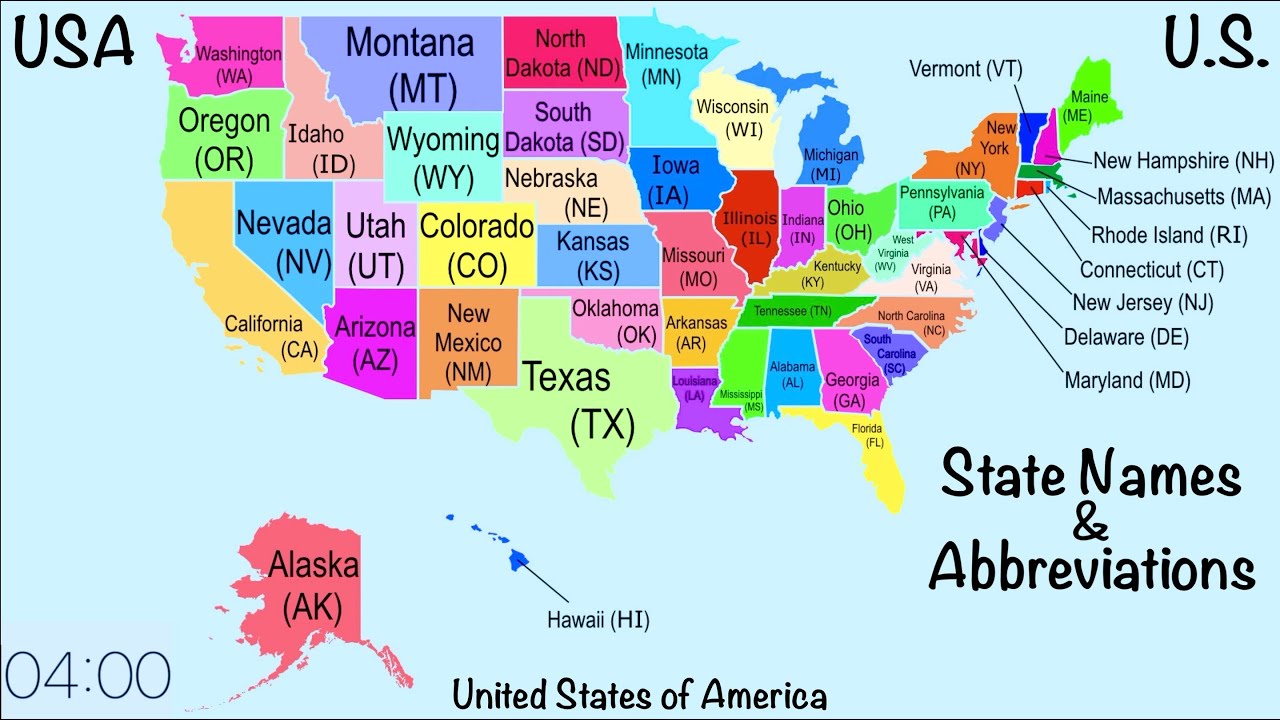
You’ve probably seen it a thousand times. You’re looking at a map of america with state abbreviations and you find yourself staring at "MS" and "MI" and "MO" wondering which one is which. Honestly, it’s a mess. Most of us just assume these two-letter codes have been around since the Founding Fathers were scribbling on parchment, but that’s not even close to the truth. The postal codes we use today are actually a relatively modern invention, born out of a mix of bureaucratic necessity and the limitations of early 1960s computer processing.
Before 1963, people just wrote out the whole name or used whatever random abbreviation felt right at the time. You’d see "Penn." for Pennsylvania or "O." for Ohio. It was chaotic for the post office.
The Weird History Behind Your Map of America with State Abbreviations
If you look at an old map, the labels are all over the place. The United States Post Office Department—what we now call the USPS—decided they needed to standardize everything because they were introducing the ZIP code system. They needed to make room for those five digits on an envelope, so they chopped every state name down to two capital letters.
It wasn't just about style. It was about space.
Think about "Massachusetts." That’s a long word to cram onto a tiny mailing label alongside a five-digit number. By forcing everything into a two-letter format, the USPS made it possible for early sorting machines to process mail without choking on the data. But this created a massive headache for the "M" states. We have eight states that start with M. Eight!
- MI (Michigan)
- MN (Minnesota)
- MS (Mississippi)
- MO (Missouri)
- MT (Montana)
- ME (Maine)
- MD (Maryland)
- MA (Massachusetts)
If you're looking at a map of america with state abbreviations, this is usually where people trip up. Why is Missouri "MO" and not "MI"? Well, Michigan already claimed "MI." Why is Maine "ME"? Because "MA" was taken by Massachusetts. It’s basically a first-come, first-served land grab of the alphabet.
Why Some Abbreviations Feel Totally Wrong
Have you ever looked at Alaska (AK) or Arizona (AZ)? Those make sense because they use the first and last letters. But then you get to something like Nevada (NV) or Nebraska (NE). There is no "perfect" logic that applies to the whole map. It’s a patchwork.
Back in the day, the official abbreviation for Nebraska was actually "NB." But the USPS changed it to "NE" in 1969 because people kept confusing "NB" with New Brunswick in Canada. Imagine trying to send a letter to Omaha and it ends up in a Canadian maritime province. That’s the kind of real-world friction that shaped the maps we use today.
Similarly, "AL" for Alabama and "AK" for Alaska are often swapped by accident. It's a common mistake. Even major news networks get it wrong sometimes during election nights when they’re rushing to fill in a digital map.
Using a Map of America with State Abbreviations for Data and Logistics
It isn't just for mailing letters anymore. If you work in logistics, data science, or even just a job that involves a lot of Excel spreadsheets, these codes are your best friend. They are the universal language of American geography.
Using the full names of states in a database is a nightmare. Someone will spell "Mississippi" with three 's' instead of four, and suddenly your data is broken. But "MS" is hard to mess up. Mostly.
When you’re looking at a professional map of america with state abbreviations, you’re seeing a tool designed for speed. In the shipping industry, every millisecond of scanning counts. Trucks moving from "CA" to "NY" rely on these codes to keep the supply chain from collapsing. It's basically the shorthand that runs the country.
The "N" State Confusion
The "New" states are another cluster of potential errors.
- NH (New Hampshire)
- NJ (New Jersey)
- NM (New Mexico)
- NY (New York)
At least these are somewhat intuitive because they all follow the "First letter of each word" rule. But compare that to the "I" states. Idaho is "ID," which everyone recognizes as "Identification." Iowa is "IA." If you're not looking at a labeled map, it's incredibly easy to flip those in your head.
I remember talking to a geography teacher who said the easiest way to memorize these is to group them by their "ending" letter rather than the first. It’s a weird trick, but it works for some people. Instead of looking at the A-states as a group, look at the "S" endings: MS, KS, RS (wait, there is no RS—see, it’s easy to get confused).
Visualizing the Map: Regions Matter
When you look at a map of america with state abbreviations, the visual layout usually helps more than the letters themselves. Geography is contextual. You know that "VT" is Vermont because it's that skinny little triangle tucked next to New Hampshire (NH) in the Northeast. If you saw "VT" floating in the middle of the Pacific Ocean, you might think it was a typo for "VA" (Virginia).
The Northeast is the hardest part of the map to label. Rhode Island (RI), Connecticut (CT), and Delaware (DE) are so small that most maps have to use "callout boxes" or lines pointing to the ocean just to fit the abbreviation.
Modern Variations and Digital Maps
In 2026, we’re seeing a shift toward interactive maps. You don't just see a static image anymore. You hover over "OR" and it pops up "Oregon." But even with all this technology, the two-letter code remains the gold standard.
Why? Because it’s clean.
Designers love the two-letter code. If you’re building a dashboard for a business, you don't want "South Dakota" taking up half the screen when "SD" does the job perfectly. It’s a matter of visual economy.
Common Mistakes to Avoid When Reading the Map
There are a few "danger zones" on the American map where the abbreviations are almost designed to trick you.
- AR vs. AZ vs. AK: Arkansas, Arizona, and Alaska.
- MA vs. ME vs. MD: Massachusetts, Maine, and Maryland.
- CO vs. CT: Colorado and Connecticut.
Honestly, the "AR" one is the worst. People see "AR" and think "Arizona" all the time, but Arizona is "AZ." Arkansas gets the "AR" because it’s the first and second letters. Arizona had to skip to the "Z" to stay distinct.
And don't even get started on the offshore territories. PR is Puerto Rico, GU is Guam, and VI is the Virgin Islands. They aren't states, but they show up on these maps more often than you’d think, especially in federal documents or shipping apps.
How to Actually Memorize the Map
If you’re trying to learn these for a test or a new job, stop trying to memorize a list. Lists are boring and your brain hates them. Instead, get a blank map—just the outlines—and try to write the abbreviations in the physical space of the state.
The spatial connection between the shape of Texas and the letters "TX" is much stronger than just seeing them on a spreadsheet.
- Start with the corners: WA, CA, ME, FL.
- Fill in the "Islands": HI and AK.
- Do the "M" states last. They are the final boss of American geography.
Actionable Steps for Mastering State Abbreviations
If you're dealing with a map of america with state abbreviations for a project or just for your own knowledge, here is how you handle it like a pro.
First, always verify the "M" and "N" states twice. These are the highest-error regions in any data entry task. If you're building a website or a form, use a dropdown menu that includes both the abbreviation and the full name (e.g., "CA - California"). This prevents the "I thought AR was Arizona" mistake from ruining your shipping labels or customer database.
Second, if you are designing a map, use a sans-serif font for the abbreviations. Serif fonts (the ones with the little feet) can make "I" look like "L" or "1" depending on the zoom level. A clean, bold font like Arial or Helvetica ensures that "IL" (Illinois) is clearly readable and not confused with "1L" or something else entirely.
Finally, keep a printed reference handy if you do this for work. Even experts blank out sometimes. There’s no shame in double-checking if "KY" is Kentucky or if you've accidentally invented a new state. Keep the map visual, keep it simple, and remember that these codes exist to make life faster, not harder.