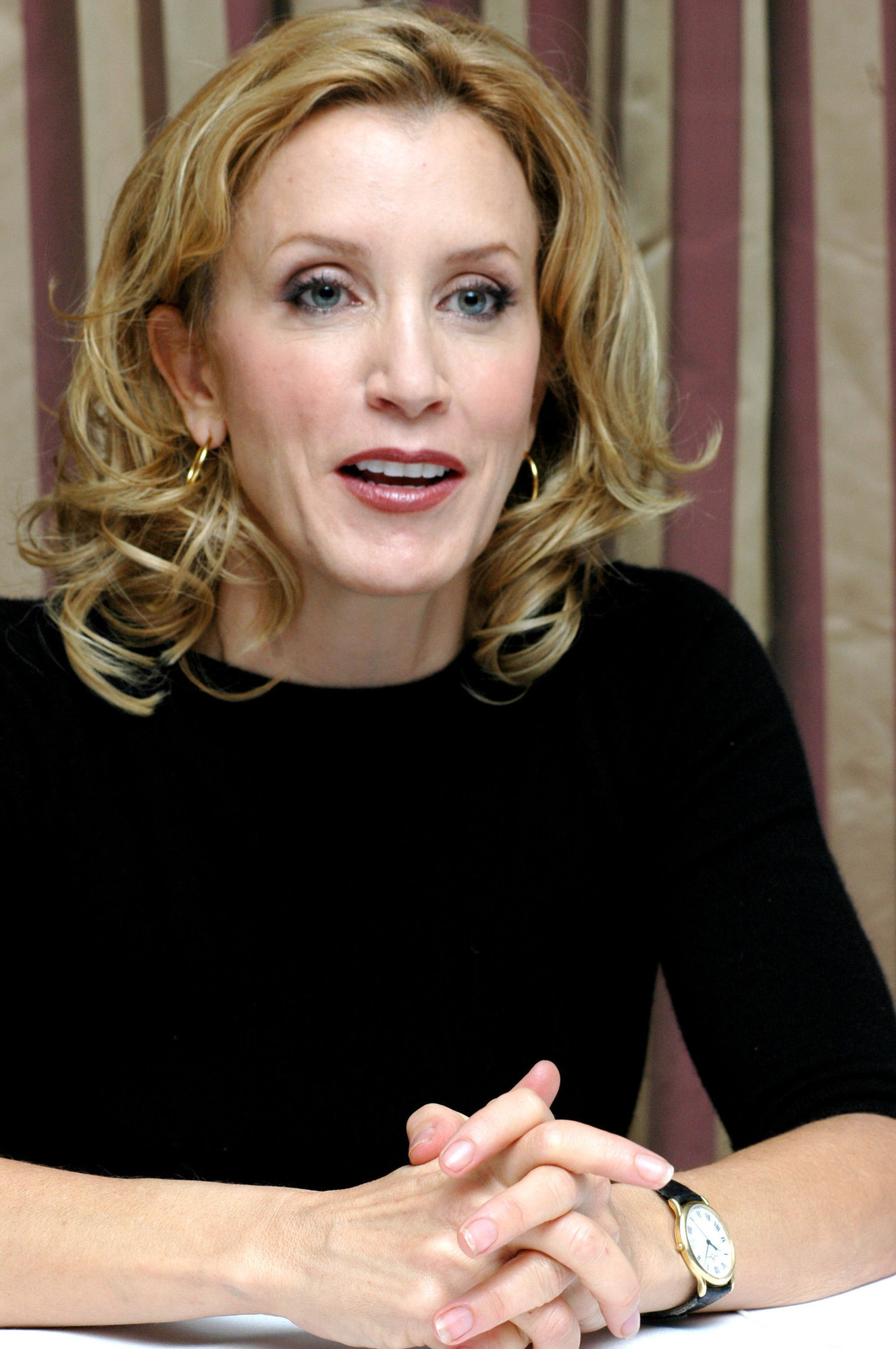
Most people think Felicity Huffman just "appeared" on Wisteria Lane in 2004, fully formed as the stressed-out, pill-popping, relatable Lynette Scavo. That couldn't be further from the truth. By the time Desperate Housewives became a global juggernaut, Huffman had already spent twenty years in the trenches of New York theater and gritty TV guest spots. She wasn't an overnight success; she was a battle-hardened veteran of the "acting-for-your-supper" lifestyle.
The story of a younger Felicity Huffman is actually a masterclass in the "Atlantic Theater" style of acting—brutally honest, technically precise, and completely devoid of vanity.
The "Flicka" Years and the Colorado Escape
Born in Bedford, New York, in 1962, Huffman was the youngest of eight children. Think about that for a second. Being the baby in a house with seven older sisters means you either get very loud or very good at observing people. She chose both. Her nickname, "Flicka," came from the book My Friend Flicka, and it stuck so hard she was actually credited as "Flicka Huffman" in her very first TV appearance, a 1978 ABC Afterschool Special called A Home Run for Love.
Honestly, she wasn't some child prodigy. She has openly admitted she was shaking so hard during her first professional shots that they had to stop filming.
She eventually headed to the Interlochen Arts Academy in Michigan for high school. It’s a legendary pressure cooker for young artists. After that, she did the thing every serious actor does: she went to London to study at the Royal Academy of Dramatic Art (RADA) before finishing up at NYU’s Tisch School of the Arts.
The Mamet Connection: Where It All Changed
If you want to understand why younger Felicity Huffman has that specific, rapid-fire delivery, you have to look at David Mamet. In the mid-80s, Huffman and her future husband, William H. Macy, were part of a group of NYU students who followed Mamet to Vermont and Chicago to form what became the Atlantic Theater Company.
This wasn't glamorous.
We're talking about a group of actors who had to chip in five dollars at every meeting just to keep the lights on. They didn't have cell phones; they celebrated getting a single landline for the office like they’d won the lottery. This era defined her. She learned "Practical Aesthetics," an acting technique that focuses on the physical action of the scene rather than getting lost in your own "feelings."
The Madonna Hand-Me-Down
In 1988, Huffman got her big Broadway break, but it came with a weird catch. She replaced Madonna in the Broadway production of Mamet’s Speed-the-Plow. Imagine the pressure. You’re taking over a role from the biggest pop star on the planet. Critics were waiting to pounce, but Huffman held her own.
The 90s: A Professional Guest Star
Before she was a household name, she was a "working actor." You’ve probably seen her in the background of your favorite 90s reruns without even realizing it.
- Law & Order (1992): She played a Diane-Keaton-esque character in an episode called "Helpless."
- The X-Files (1993): In the episode "Ice," she played a researcher trapped in an Arctic outpost. It’s a fan-favorite "bottle episode."
- Hackers (1995): She had a small role as a prosecuting attorney.
- Frasier (2003): Just before her big break, she had a multi-episode arc as Julia Wilcox, Frasier's prickly, high-maintenance girlfriend.
But the real turning point—the one that made critics sit up and realize she was a powerhouse—was Sports Night.
Why Sports Night Still Matters
Created by Aaron Sorkin, Sports Night (1998-2000) was way ahead of its time. Huffman played Dana Whitaker, the executive producer of a sports news show. She was fierce, neurotic, and incredibly fast. It was the first time the world saw that Huffman could carry a show.
She has spoken about how hard she found the character’s romantic tension with Casey McCall (Peter Krause). She actually found it "unsatisfying" as an actor when the writers kept them apart for so long. She wanted the payoff. That frustration probably fueled the high-wire energy she brought to the role, which eventually earned her a Golden Globe nomination.
The William H. Macy "Fairytale" (That Took 15 Years)
You can't talk about a younger Felicity Huffman without mentioning Bill Macy. They met at the Atlantic Theater Company in the early 80s. He was her teacher. They dated on and off for fifteen years.
Wait—fifteen years?
Yeah. Huffman was reportedly terrified of marriage. She felt like it would swallow her identity. Macy proposed multiple times, and she kept saying no. It wasn't until 1997 that they finally tied the knot. By then, they were the "power couple" of the off-Broadway scene, even if the rest of the world hadn't caught on yet.
Transitioning to Motherhood and Wisteria Lane
By the time Huffman was 37, she was a first-time mom. She has been brutally honest about how much she struggled with motherhood. She didn't feel "graceful." She felt overwhelmed, sleep-deprived, and like she was making mistake after mistake.
This sounds familiar, right?
That's because that exact "messy" energy is what she brought to the audition for Desperate Housewives. Most of the other actresses showed up looking like, well, housewives. Huffman showed up looking like a woman who hadn't slept in three years. She got the part on the spot.
Actionable Insights from Huffman's Early Career
If you’re looking at Huffman’s trajectory as a blueprint for success, here is what actually worked:
- Technical Foundation First: She didn't chase fame; she chased craft. Spending ten years in theater before hitting it big in TV meant she had the "acting muscles" to handle a lead role when it finally arrived.
- The Power of "No": She didn't jump at every role. She worked with people she respected (like Mamet and Sorkin) and stayed loyal to her theater roots even when she was broke.
- Authenticity Over Vanity: Huffman’s biggest successes came when she stopped trying to look "perfect" and started showing the "ugly" side of being a woman—the stress, the anger, and the exhaustion.
The legacy of a younger Felicity Huffman isn't just about the awards she eventually won. It’s about the two decades she spent becoming the kind of actor who could actually deserve them. She proved that longevity in Hollywood isn't about the first big break; it's about the twenty years of preparation that happen before anyone is even watching.